
Historical Context
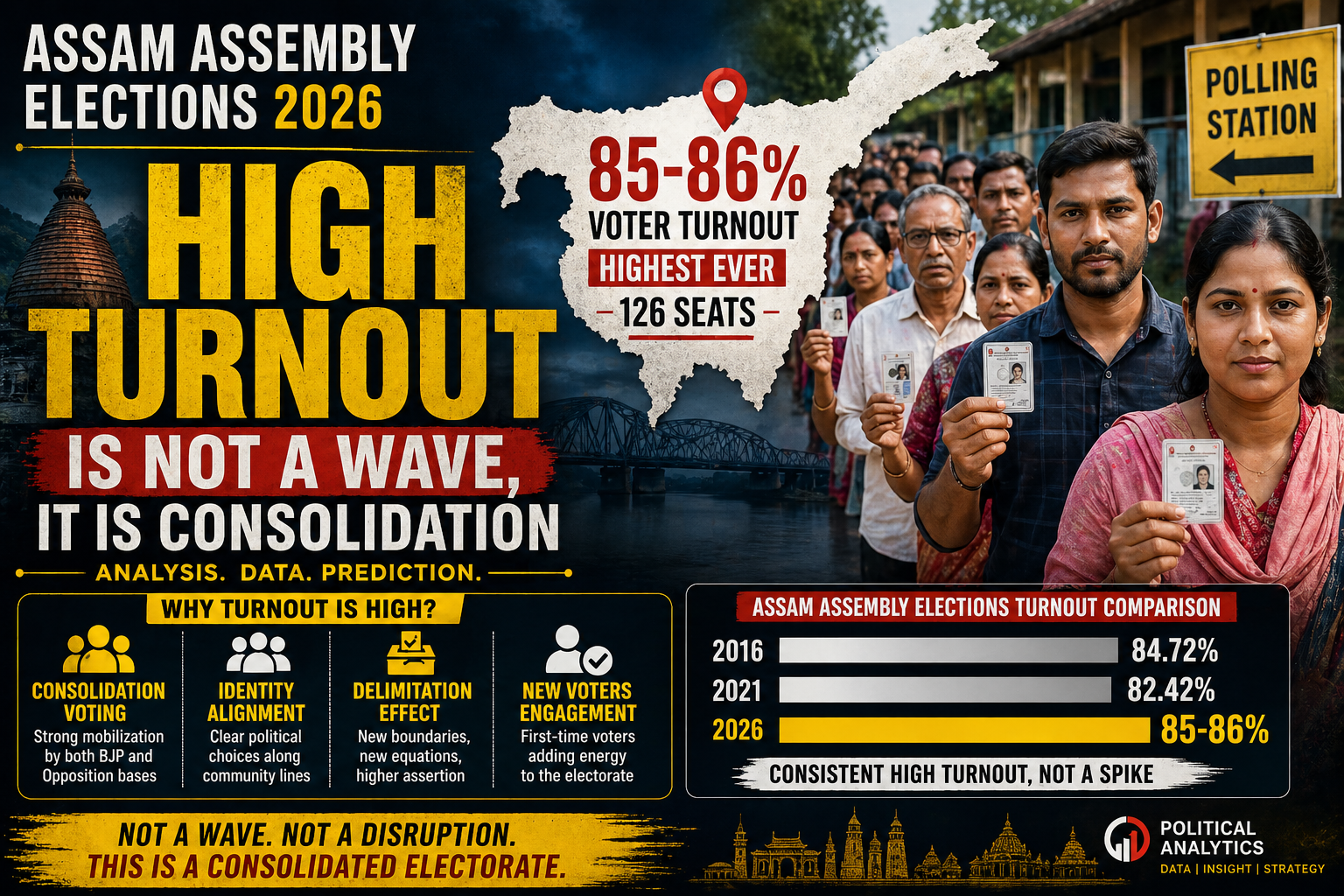
To understand the significance of the 2026 turnout, it is important to examine Assam’s historical voting behavior. Over the past decade, Assam has consistently remained a high-turnout state. The 2011 Assembly elections recorded approximately 76 percent turnout, which increased significantly to 84.72 percent in 2016. In 2021, turnout stood at around 82.42 percent, and in 2026 it has once again reached approximately 85–86 percent. This consistent pattern shows that Assam’s electorate has remained highly engaged over time. The 2026 turnout, therefore, is not an anomaly or a sudden spike, but a continuation of an already active and participatory political environment.
Nature of Turnout
Unlike elections in states where turnout surges are driven by fear, administrative disruptions, or anger against the system, Assam presents a different picture. The 2026 turnout reflects a stable and predictable pattern of voter participation. Voters are not reacting to sudden triggers but are participating as part of an established democratic habit. This suggests that the electorate is politically aware, aligned, and consistent in its behavior. There is no evidence of a sudden emotional wave influencing participation. Instead, turnout reflects a mature electoral system where voting is normalized and expected.
Impact of Delimitation
One of the key structural factors shaping the 2026 election is the impact of delimitation. The redrawing of constituency boundaries has significantly altered the demographic composition of several seats, creating new political dynamics. This has led to increased voter participation as communities attempt to assert their presence and influence within newly structured constituencies. The election is therefore not just about political preference but also about territorial and demographic assertion. Turnout in this context becomes a reflection of communities adjusting to a new political map rather than reacting to short-term political narratives.
Political Contest and Alignment
The electoral contest in Assam remains largely bipolar, primarily between the BJP-led alliance and the Congress-led opposition. The BJP continues to hold a structural advantage, particularly in Upper Assam, tribal regions, and urban constituencies, supported by strong organizational networks and leadership projection. The alliance had secured 75 out of 126 seats in the 2021 elections, demonstrating its ability to convert support into electoral outcomes. On the other hand, the Congress and its allies remain strong in Lower Assam and minority-dominated constituencies. The high turnout in these regions indicates effective consolidation of their core vote base. However, their challenge remains the inability to expand significantly beyond these strongholds.
Geographic Polarization
A critical aspect of the 2026 turnout is its uneven distribution across regions. Higher turnout has been observed in Lower Assam, particularly in areas with strong identity-based voting patterns, while Upper Assam has shown slightly lower but stable participation levels. This indicates that turnout is not uniform but concentrated in specific demographic zones. Such a pattern suggests that political polarization is shaping voter behavior, with different communities mobilizing within their respective strongholds. This reinforces the idea that turnout reflects consolidation rather than a broad-based wave across the state.
Turnout and Electoral Direction
One of the most common analytical errors in election studies is equating high turnout with political change. Assam’s electoral history clearly demonstrates that this assumption does not always hold. High turnout in 2016 resulted in a regime change, while a similarly high turnout in 2021 led to continuity of the incumbent government. The 2026 turnout, therefore, cannot be interpreted as a definitive indicator of political direction. Turnout reflects participation levels, not voter preference. The actual electoral outcome will depend on how different voter segments have aligned within this high-participation environment.
Prediction
Based on current turnout patterns, historical data, and structural factors, the most likely scenario is that the BJP-led alliance retains its advantage. The party’s strength in Upper Assam and its ability to convert votes efficiently into seats gives it a clear edge. A second possible scenario is that the opposition gains ground in Lower Assam and minority-dominated constituencies, narrowing the gap but not fundamentally altering the overall balance of power. A fragmented mandate appears less likely, as current data does not indicate significant cross-community voting or breakdown of existing political alignments.
Determinants of Outcome
The final outcome of the election will not be decided by turnout alone. Instead, it will depend on micro-level factors such as booth-level vote conversion efficiency, performance in mixed demographic constituencies, and the effectiveness of alliance vote transfers. In a high-turnout environment, even small variations at the booth level can lead to significant changes in seat outcomes. This makes ground-level execution far more important than broad narratives.
Conclusion
The Assam Assembly Elections 2026 are not witnessing a wave election but a consolidation election. The high turnout reflects stable political alignments, strong voter participation, and reinforcement of existing vote blocs. This is not an election driven by disruption or unpredictability, but one shaped by structure, alignment, and efficiency. In this context, turnout is not the central story. The real story lies in how this turnout is distributed across regions and communities, and how effectively it is converted into electoral success.