
A Departure from Historical Voting Patterns
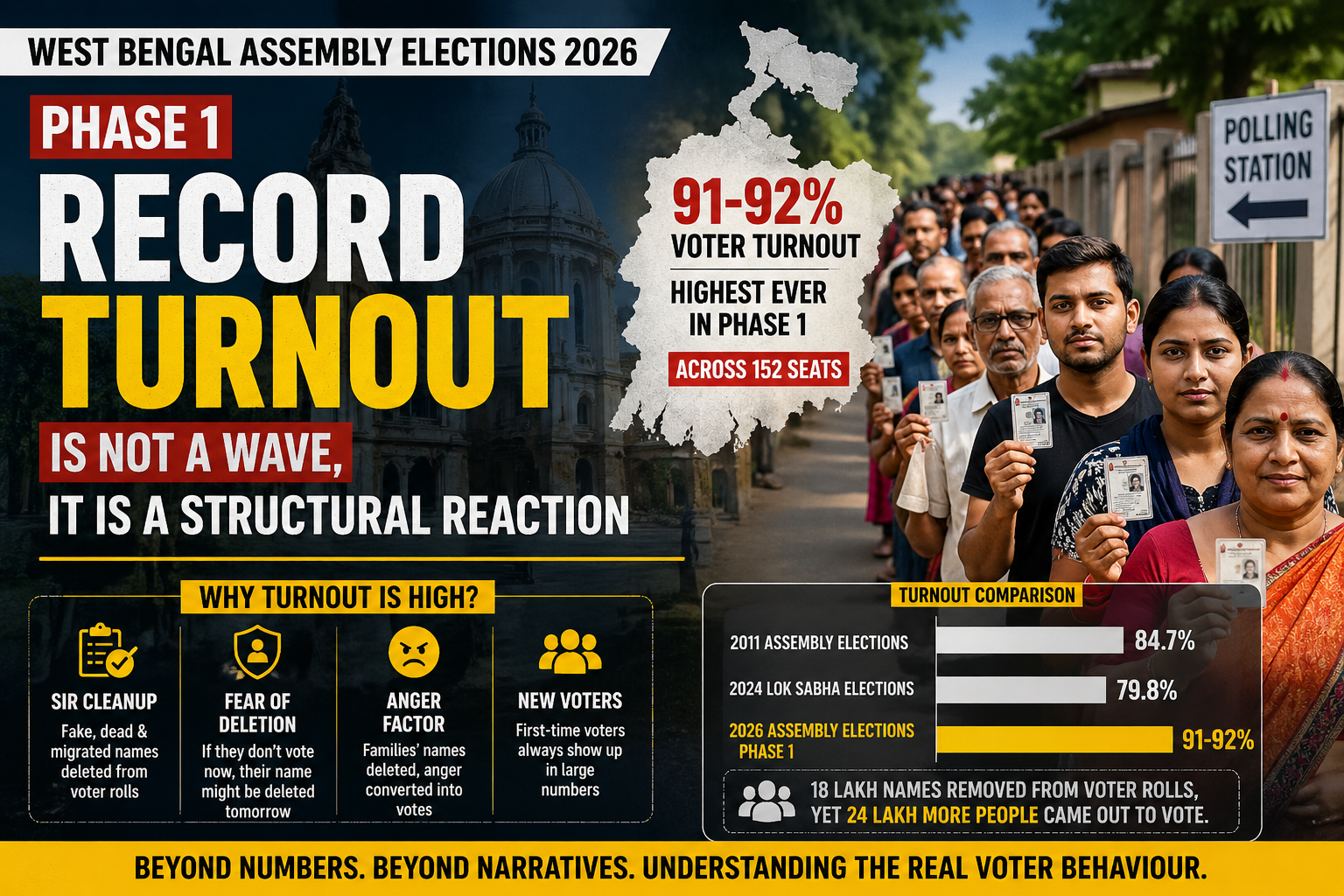
When placed in historical context, the current turnout appears significantly disproportionate. The 2011 Assembly elections recorded a turnout of approximately 84.7 percent, while the 2024 Lok Sabha elections in West Bengal saw participation around 79–80 percent. In contrast, Phase 1 of the 2026 Assembly elections has crossed the 90 percent mark, making it one of the highest recorded in the state’s electoral history.
What makes this even more significant is the fact that the total number of registered voters has actually declined due to recent voter list revisions. Despite this reduction, the number of actual votes cast has increased substantially compared to previous elections. This simultaneous rise in turnout percentage and absolute voting numbers is not typical electoral behavior. It points toward a system-driven shift rather than a purely political one.
The SIR Effect: Structural Correction of the Voter Base
The most important factor behind this shift is the voter roll revision process. The removal of names classified as fake, duplicate, deceased, or migrated has resulted in a cleaner and more accurate voter list.
This structural correction has had a direct mathematical impact. With inactive or non-existent voters removed from the rolls, the turnout percentage naturally increases. However, the impact goes beyond numbers. A cleaner voter base creates a sense of increased relevance among genuine voters. Each vote carries greater weight, and participation becomes more meaningful.
This is not just high turnout; it is a more efficient turnout, driven by a corrected denominator.
Fear of Disenfranchisement and Identity Anxiety
Beyond structural changes, the election has been shaped by a strong psychological undercurrent. The voter list revision process has created a perception among citizens that electoral inclusion is no longer guaranteed.
A significant number of voters now believe that failing to participate could lead to their names being removed in future revisions. This fear is not limited to voting rights alone. It extends to concerns about identity, documentation, and long-term inclusion within the system.
As a result, voting in this phase has taken on a defensive character. It is no longer just an exercise of choice, but an assertion of presence. For many voters, participation is a way of safeguarding their identity within the administrative framework.
Anger and Reactionary Voting Behavior
Another key dimension is the role of emotion, particularly anger. Reports from multiple constituencies indicate that families discovered missing names of relatives, whether due to migration, administrative errors, or documentation gaps.
This has generated resentment and frustration at the ground level. In such cases, voting becomes a reaction rather than a preference. Individuals who might otherwise have remained neutral or disengaged are mobilized by grievance. This form of reactionary participation contributes significantly to turnout but does not necessarily translate into consistent support for any one political party.
Instead, it introduces volatility into the electoral outcome.
Migrant Participation and Reverse Mobilization
A less visible but critical factor is the return of migrant voters. The perception that names are being removed from voter lists has prompted many individuals working outside their home constituencies to return specifically to cast their votes.
This reverse mobilization has contributed to the increase in absolute voting numbers. Unlike previous elections, where turnout was largely dependent on local participation, the current phase reflects a broader geographic engagement of voters.
This trend further reinforces the idea that turnout in 2026 is being driven by compulsion and awareness, rather than routine political engagement.
New Voters and First-Time Participation
The role of new voters has also been significant. First-time voters generally display higher enthusiasm and are more likely to participate actively. In the current election, this effect is amplified by increased awareness around electoral processes and documentation.
Young voters are more conscious of their inclusion in official systems and are therefore more responsive to narratives around voter registration and identity. Their participation adds another layer to the already elevated turnout levels.
Turnout Does Not Indicate Political Direction
One of the most common analytical errors is equating high turnout with a clear electoral trend. In reality, turnout is a measure of participation, not preference.
In Phase 1 of the 2026 elections, the drivers of turnout are diverse and often contradictory. Structural corrections, fear of exclusion, emotional reactions, and new voter enthusiasm do not align with a single political narrative. They cut across party lines and voter groups.
As a result, interpreting this turnout as a straightforward indicator of anti-incumbency or a wave election would be misleading. The actual direction of the election will depend on how these different segments have voted within this high-participation environment.
Strategic Implications
For political stakeholders, the key takeaway is that voter behavior is increasingly influenced by administrative processes and identity concerns, rather than just campaign messaging. Traditional assumptions about vote banks and turnout patterns may not hold in such a scenario.
The real advantage will lie with those who can decode this participation at a granular level. Booth-level analysis, community-wise turnout patterns, and conversion efficiency will determine electoral outcomes far more than overall turnout figures.
Conclusion
The high turnout in Phase 1 of the West Bengal Assembly Elections 2026 is not a simple reflection of democratic enthusiasm or political momentum. It is the outcome of a complex interplay of structural, psychological, and emotional factors.
The election is not just being fought through campaigns and narratives. It is being shaped by deeper questions of identity, inclusion, and administrative trust. This makes the contest far more unpredictable than it appears on the surface.
In this context, turnout is not merely a statistic. It is a signal of a changing electoral landscape, where participation is driven as much by compulsion as by choice. The final outcome will depend not on how many voted, but on how effectively this behavior is understood and converted into electoral advantage.