
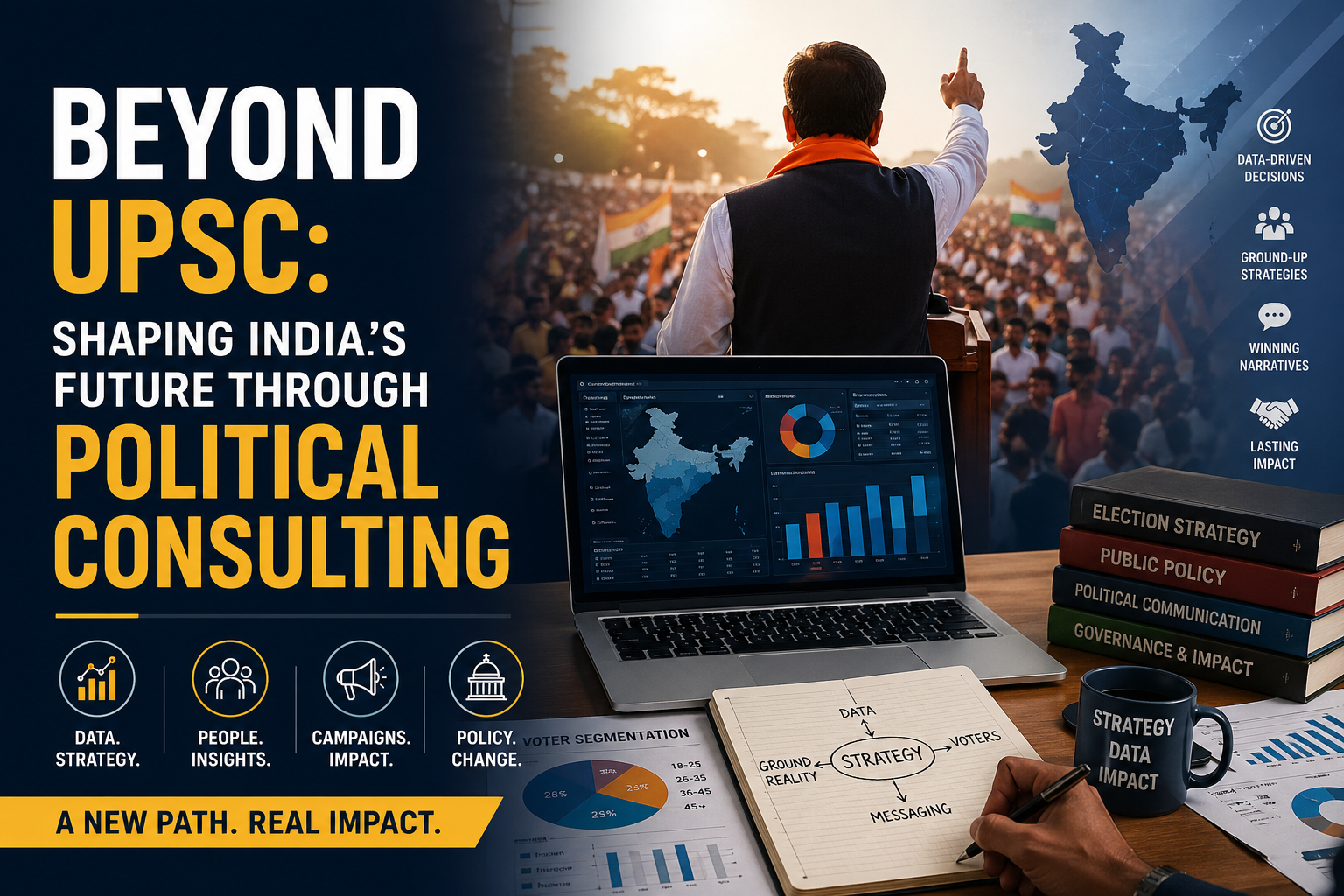
The Hard Truth No One Tells You
UPSC teaches you how the system works.
Political consulting decides who runs the system.
One prepares you for governance.
The other shapes power itself.
And in a country where elections are becoming more data-driven, more psychological, and more strategic —
the people influencing outcomes are no longer just politicians.
They are consultants.
Why Political Consulting Is Exploding Right Now
Elections today are not fought on speeches alone. They are engineered through:
Booth-level data modeling
Voter segmentation and micro-targeting
Narrative control across digital platforms
Ground intelligence and rapid feedback loops
Every campaign today is a war room —
and political consultants are the ones running it.
The demand for sharp, execution-focused minds is rising fast —
but the supply is still limited.
That’s the gap.
Let’s be blunt.
A UPSC aspirant already has:
System-level understanding
Analytical depth
Discipline and resilience
Ability to process complex information
But here’s the problem:
Most aspirants are trained to study the system, not play the game.
Political consulting flips that.
It rewards:
Speed over perfection
Insight over theory
Execution over memorization
If UPSC is preparation,
consulting is application at scale.
The Real Skill Shift: From Theory to Control
To succeed in political consulting, you don’t need more knowledge —
you need sharper decision-making tools.
1. Data Is Your Weapon
Opinions don’t win elections. Insights do.
If you can’t read data, identify patterns, and translate them into strategy —
you’re irrelevant.
2. People > Numbers
Data tells you what.
Ground understanding tells you why.
The ability to decode:
Anger
Aspirations
Silent voter shifts
…is what separates average consultants from campaign architects.
3. You Must Think in Uncertainty
Perfect data doesn’t exist in politics.
You will constantly:
Estimate voter blocks
Predict campaign impact
Take calls with incomplete information
This is where most people fail.
Consultants don’t wait for clarity.
They create it.
4. Hyper-Local Is Everything
Delhi-level thinking doesn’t win panchayat-level battles.
Real strategy is built booth by booth, village by village, caste cluster by caste cluster.
If you don’t understand the ground —
you don’t understand politics.
5. Awareness Is a Competitive Advantage
In politics, being late by 24 hours is the same as being irrelevant.
The best consultants:
Track narratives daily
Anticipate shifts before they happen
Position candidates ahead of the curve
This is not knowledge.
This is situational intelligence.
6. Your Network Is Your Leverage
Let’s not sugarcoat it.
Access matters.
Opportunities in political consulting don’t come from job portals —
they come from ecosystems.
If you’re not visible, connected, and active —
you’re out of the game before it starts.
The Gap: Why Most Aspirants Never Make This Shift
It’s not because they lack capability.
It’s because they lack:
Direction
Exposure
Real-world application
They stay stuck in preparation mode —
while the industry moves ahead without them.
Where Structured Entry Changes the Game
This is where platforms like Rebounce become relevant.
Not because they teach theory —
but because they bridge the only gap that matters:
From knowledge → execution → placement
With:
Real campaign-style projects
Practical data and strategy training
Direct exposure to the ecosystem
The result?
Aspirants transitioning into consulting roles within months —
some landing packages of 20+ LPA.
Not by starting from scratch —
but by repositioning what they already know.
The Real Question You Need to Ask Yourself
Do you want to:
Wait years to enter the system
Or
Start influencing outcomes right now
Because that’s the difference.
UPSC is a long, uncertain road to authority.
Political consulting is a faster path to impact and relevance.
Final Take
Political consulting is not Plan B.
It is where modern politics is actually being shaped.
And if you already understand governance, society, and power —
then stepping into consulting isn’t a shift.
It’s an upgrade.